
Did you know that most doctors will only check TSH (thyroid stimulating hormone) when investigating the thyroid? Getting a FULL thyroid panel with antibodies is important when checking for thyroid conditions. We recommend a full thyroid panel, as we see many clients with autoimmune conditions, in the early stages of hypothyroidism, or with subclinical hypothyroidism that may be misdiagnosed with a standard panel that checks TSH levels.
While TSH can provide some information about thyroid health/function, it does not tell the whole story. An individual’s TSH levels may appear completely normal, but they could have antibodies starting to attack the thyroid. It may take years before TSH levels are impacted, and by then, there may be significant damage to the thyroid.
By running a full thyroid panel, you not only get a better idea of what is going on with your thyroid but are more likely to catch thyroid dysfunction early on and prevent future damage.
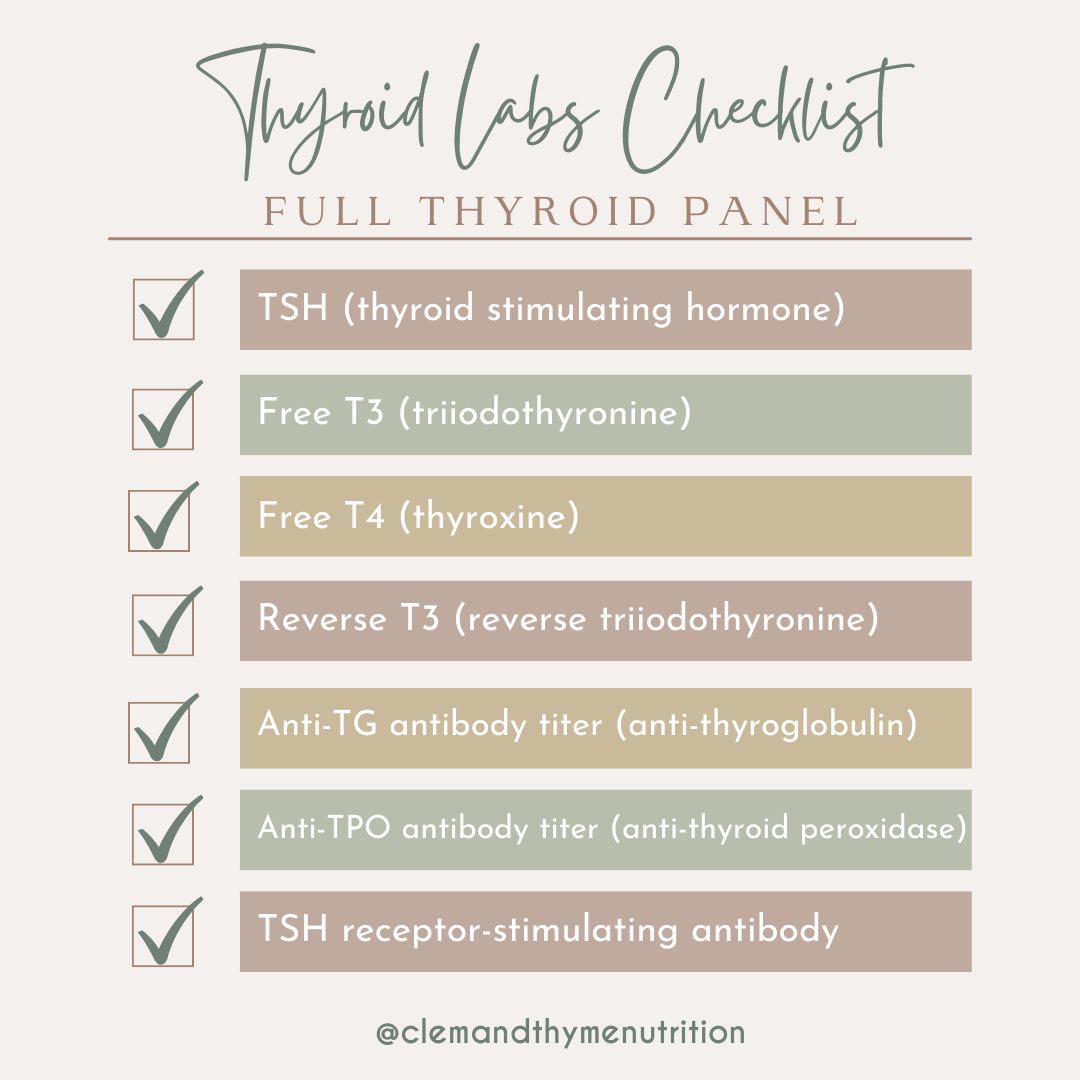
The Full Thyroid Panel to Request:
What labs should you include in a full thyroid panel?
✔️ TSH (thyroid stimulating hormone) – A hormone secreted by the pituitary gland that tells the thyroid gland to make & release thyroid hormone into the blood as needed.
✔️ Free T3 (triiodothyronine) – The less abundant but much more potent thyroid hormone. T3 plays a role in regulating digestion, muscle control, brain function, bone health, & heart function. It also controls metabolism & body temperature. Free T3 is the active form. It is directly produced by the thyroid gland & also from T4 converting to T3 throughout the day.
✔️ Free T4 (thyroxine) – The more abundant but less potent thyroid hormone. T4 plays a role in metabolism, mood, and body temperature. Free T4 is the active form.
✔️ Reverse T3 (reverse triiodothyronine) – An inactive form of hormone elevated in the setting of stress, metabolic issues, inflammation, and illness.
✔️ Anti-TG Antibody Titer (anti-thyroglobulin) – A protein found in thyroid cells that tests for antibodies to this protein and detects autoimmune thyroid disease.
✔️ Anti-TPO Antibody Titer (anti-thyroid peroxidase) – A protein found in thyroid cells that test for antibodies to this protein. The most sensitive test for detecting autoimmune thyroid disease.
✔️ TSH Receptor-Stimulating Antibody
If you have concerns for your thyroid health, ask your doctor to run a FULL thyroid panel. If your doctor is not willing to order a full panel, we can order one through RUPA Health.
Thyroid Lab Interpretation
Have you ever received bloodwork back, and despite your doctor telling you everything was “normal,” you still did not feel right? This conclusion may be because they used standard reference ranges instead of optimal reference ranges to interpret your labs.
Standard reference ranges are broad reference ranges used to interpret labs based on the averages of a healthy population. The “normal” range is based on statistics, not on whether a specific value represents good health or function. This oversight leaves room for symptoms to worsen and disease progression left undetected.
Optimal reference ranges are tighter, evidence-based ranges used by functional medicine providers to interpret bloodwork. These narrower ranges allow functional medical providers to detect possible dysfunction early and have a chance at reversing or possibly stopping disease progression. Optimal ranges reflect good health and normal function of your body.
Once you have a full thyroid panel done, it is important to know HOW to interpret the data. These are the standard vs. optimal ranges for:
✔️ TSH
Standard: 0.4-4.5 mIU/L
Optimal: 0.5-2.5 mIU/L
✔️ Free T3
Standard: 2.3-4.2 pg/mL
Optimal: 3.2-4.5 pg/mL
✔️ Free T4
Standard: 0.8-1.8 ng/dL
Optimal: 1.2-1.5 ng/dL
✔️ Reverse T3
Standard: 11-31 ng/dl
Optimal: 11-15 ng/dl
✔️ Anti-TG Antibody Titer
Standard: 0-40 IU/ml
Optimal: < 4 IU/ml
✔️ Anti-TPO Antibody Titer
Standard: 0-34 IU/ml
Optimal: < 4 IU/ml

At Clem&Thyme Nutrition, we use optimal ranges to interpret ALL laboratory data because you deserve better than “normal” or “average.” Schedule an appointment today to get to the root cause of your symptoms and get back to feeling your best.
We hope you enjoyed this blog post “Everything You Need to Know About Getting a Full Thyroid Panel.” Let us know if this blog post helped you on your health journey.
Are you interested in booking an appointment at Clem&Thyme Nutrition? We have two convenient locations in the state of Ohio – our flagship office in Yellow Springs and an extension office in Westerville. We also offer virtual sessions and online programs. You can learn more about our registered dietitians to find the right fit for you. Click here to get started.

